I'll stand on top of the hill with God's rod in my hand.
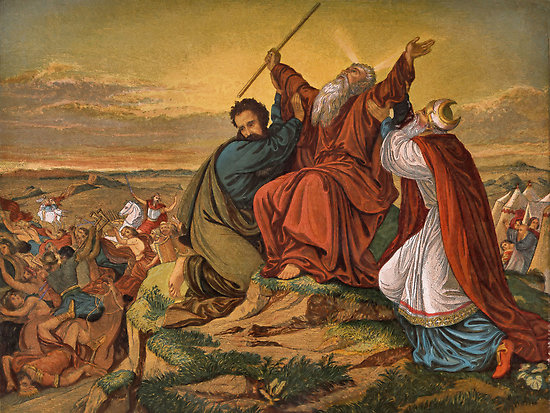
10 So Joshua fought with Amalek, while Moses, Aaron, and Hur stood on top of the hill.
11 As long as Moses kept his hand up, the Israelites were successful in battle, but the second his hand fell, they got beat.
12 But Moses's hands were heavy, so they sat him on a stone and had Aaron and Hur hold up his hand. They continued to hold up his hand until the sun went down.
The story about manna have arisen from Trabutina mannipara, a species mealybug in the order Hemiptera.
T. mannipara inhabits the Sinai peninsula and feeds on tamarisk trees. It excretes a sweet, sticky substance that is sometimes collected and used as food for humans.
Don't gather the bread on the Sabbath. (6:23)
This is the first reference to the Sabbath in the Bible.
Aaron put a pot of manna before the testimony. (16:34)
"The testimony" here refers to the ark containing the stone tablets -- that didn't exist yet, since they were supposedly written with the finger of God in Exodus 31:18.
The Bible says nothing about how Moses greeted his wife and children - or if he greeting them at all.
It doesn't say whether they returned to Midian with Jethro (which seems likely) or remained with Moses during the Exodus.
Zipporah - who saved Moses from being killed by God (Exodus 4:24-26) is never again mentioned in the Bible. And neither are her sons, Gershom and Eliezar, except in genealogies.
Jethro sacrificed a burnt offering for God. (18:12)
Jethro, a Midian priest, sacrificed a burnt offering to God.
Did he sacrifice it to Yahweh or to some other God of Midian?
And why didn't Moses or Aaron offer the sacrifice instead of Jethro?
And Jethro went home. (18:17)
Did he take Moses's wife and sons with him?
The Bible doesn't say, but he probably did, since they are never mentioned again.