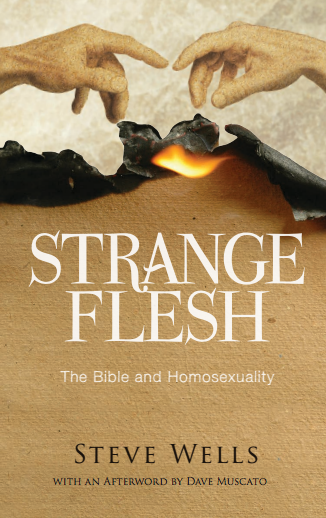
Even as Sodom and Gomorrah ... giving themselves over to fornication, and going after strange flesh, are set forth for an example, suffering the vengeance of eternal fire.
Jude 7
Even as Sodom and Gomorrah ... giving themselves over to fornication, and going after strange flesh, are set forth for an example, suffering the vengeance of eternal fire.
Jude 7
By Dave Muscato
People often ask me to recommend resources for learning about the harms of religion. For years, even before I became a professional activist, one of my top recommendations has been the Skeptic's Annotated Bible. It's often said that a Bible itself is one of the most powerful tools for turning people into atheists. I think the reason it works so well is that most religious people don't know what they are claiming to believe in. Despite the irony that many self-described Bible Believers think the Bible is the most important book ever written -- or more laughably, their favorite book--many have never actually read it cover-to-cover.
The Skeptic's Annotated Bible is the perfect way to approach that intense undertaking. It's easy, when reading along in any ancient religious text, to become desensitized and fail to give proper attention to the body count, the blatant misogyny, the inhuman homophobia, the absurd scientific inconsistencies -- and the SAB does an excellent job of making them abundantly clear in a factual, yet skeptical manner. So when Phil and Steve Wells, authors of the Skeptic's Annotated Bible -- with whom I was previously unacquainted -- wrote to me about writing the afterword for their new book, Strange Flesh, I jumped at the chance to read the manuscript.
The topic of LGBTQ rights is very closely tied to what I do for a living. It's no coincidence that half of LGBTQ Americans are not religious, a figure more than double that of the general population. Learning what the Bible actually says about homosexuality has led many Americans, directly or indirectly, to abandon their religious beliefs. If you -- as a moral person who supports LGBTQ equality -- began this book as a religious person, I hope that reading it has helped lead you to do the same.
Biblical religious teachings are in direct conflict with equality and human rights, especially in regard to, among others, those with LGBQT orientations. People to claim to be Bible believers and who also claim to support LGBTQ equality are contradiction themselves. Is it possible to be religious and support the right for gay people to engage in sexual relations if they so desire?
Not if a person identifies as a Bible believer.
There is no question that the Bible prohibits gay sexual relations (Leviticus 20:13) and that -- according to the Bible -- engaging in such behavior is detestable. In the Bible, God himself, speaking directly to Moses, orders execution as punishment for homosexual acts.
Lest Christians think that Jesus wiped clean the slate and the Old Testament law no longer applies, consider what Jesus said in Matthew 5:17-19:
Think not that I am come to destroy the law, or the prophets: I am not come to destroy, but to fulfil. For verily I say unto you, Till heaven and earth pass, one jot or one tittle shall in no wise pass from the law, till all be fulfilled. Whosoever therefore shall break one of these least commandments, and shall teach men so, he shall be called the least in the kingdom of heaven: but whosoever shall do and teach them, the same shall be called great in the kingdom of heaven.
Despite their stubborn insistence otherwise, virtually all believers actually don't get their moral compass from the Bible. If they did, they would be fine with slavery, but wouldn't even consider eating shellfish, wearing poly-cotton shirts, getting a divorce, or having sex before they were married (something virtually 100 percent of believers do.) Religion makes people into liars, which is one of the problems with it.
In reality, all of us -- believers and atheists alike -- get our ideas about what's right and wrong from the study of ethics, the changing cultures in which we live, and our own consciences. Not only do these precede the writing of the Bible, but they evolved with the times. That's good. It is unreasonable to think that our ideas about what is and isn't moral can never be improved upon, and that what was true thousands of years ago is as true today. There are certainly a lot of things that society disagrees about now that are likely to be settled one way or the other eventually. A pertinent example is the current fight for legal rights of LGBTQ people and the constantly progressing social attitude about the morality of LGBTQ relationships.
Am I "silencing" gay and ally believers by telling them that they are wrong about their belief that one can be both pro-LGBTQ and a Bible believer at the same time?
Oh, it's much worse than that.
I'm an atheist. I am telling all believers that what the claim is true about the entirety of reality is wrong.
toBeing a Bible believing Christian (or Jew, Muslim, Mormon or any other believer whose religious canon includes the Old Testament) requires a lot of ad-hoc rationalization. Some of the most creative people I know are Bible believers. They have to be, because the Bible prohibits all sorts of things believers will defend inflexibly as moral.
As supportive as I am of LGBTQ equality (and, while I consider it a private matter, as a member of the LGBTQ community myself, I certainly am supportive), quibbling about this minor aspect of Biblical doctrine seems ludicrous. Believers can cite this verse or that verse, interpret the Bible this way or that way, but it doesn't matter: after reading Strange Flesh, I believe it's clear that those who claim to be Bible believers, while also claiming to be on the side of LBGTQ rights, are lying to themselves about one of those -- and I believe that when we all learn to recognize this, the world will be a much more equal, safe, and beautiful place to call home for all of us.
Thanks for reading!
Dave Muscator,
Public Relations director, American Atheists
dmuscato@atheists.org