I'll let you know what will happen in the last end of the indignation. The end will be at the appointed time.
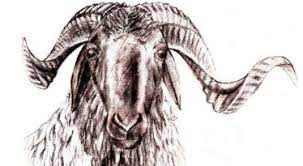
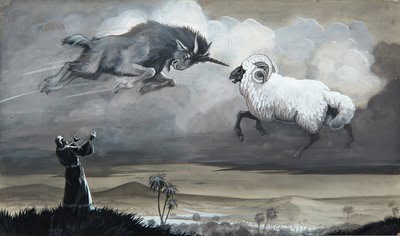
20 The two-horned ram that you saw are the kings of Media and Persia.
21 The other goat is the king of Greece, and the big horn between his eyes is the first king.
23 A fierce-looking king will stand up in the latter time of their kingdoms.
24 He'll be powerful, destroy wonderfully, and prosper. And he'll destroy the mighty and the holy people.
25 He'll magnify himself, destroy many people, and stand up against the prince of princes. But he'll be broken.
26 The morning and evening visions are true, so shut up the vision for many days.
27 And I, Daniel, fainted and was sick for a few days. Then I got up and did the king's business. I was astonished by the vision but didn't understand it.
A few more words about this episode
Daniel 8
The language switches from Aramaic back to Hebrew in this chapter.
I saw a ram with two horns. (8:3)
We've seen this story before, several times, so the characters should now be fairly obvious.
The ram with two horns is the Medio-Persian Empire, with the longer horn being Persia.
The one-horned ram attacked the ram with two horns (8:6)
The one-horned flying ram is Alexander the Great, who conquered Persia in 331 BCE.
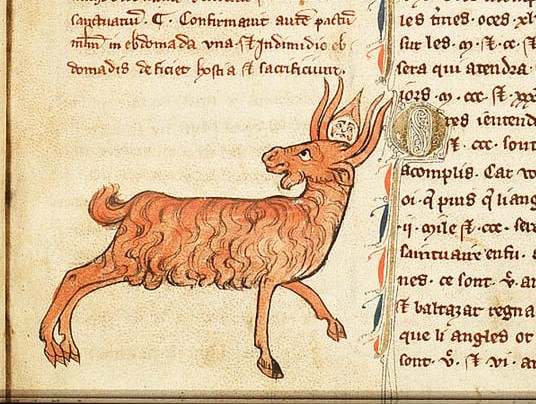
The one-horned ram broke his horn, and out of it came four more horns (8:8)
The four horns that grew out of the ram's broken horn are Alexander's four generals, who fought over his empire after his death (Antigonus, Cassander, Ptolemy, and Seleucus).
A small horn grew out of one of the four horns. (8:9)
Another magic number from the book of Daniel that has caused, and still causes, endless predictions about the end of the world.
The 2300 days is sometimes translated as 2300 evenings and mornings, which some say means half as many days - or 1150 days.
According to First Maccabees, the time between the desecration of temple by Antiochus and it's restoration was 3 years - or 1095 days. (See 1 Mac 1:54, 4:52)
Gabriel, help this man understand the vision. (8:15)
This is the first mention of the angel Gabriel in the Bible. The name only occurs four times - twice in the book of Daniel (8:15, 9:21) and twice in the gospel of Luke (1:19, 26), at the annunciation of Mary.
Gabriel interprets Daniel's vision. But we don't need his help, since its meaning is clear enough. (It's getting to be a bit tiring now.)
But he'll be broken. (8:25)
The small horn is, of course, Antiochus IV Epiphanes.
Here is how the apocryphal (or Deuterocanonical) book of Second Maccabees describes the death of Antiochus:
The God of Israel ... struck him with an incurable and an invisible plague ... a dreadful pain in his bowels came upon him, and bitter torments of the inner parts. ... So that worms swarmed out of the body of this man, and whilst he lived in sorrow and pain, his flesh fell off, and the filthiness of his smell was noisome ... And the man that thought a little before he could reach to the stars of heaven, no man could endure to carry, for the intolerable stench. 2 Maccabees 9:5-10