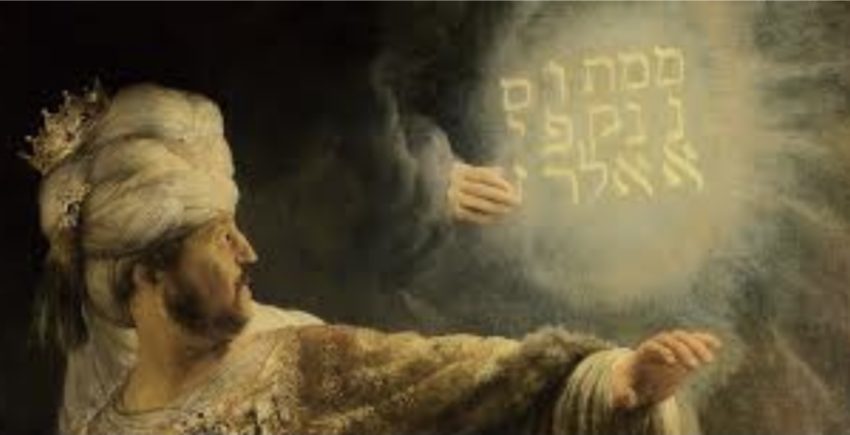
51 King Belshazzar, Nebuchadnezzar's son, had a great feast.
2-3 He had the gold and silver vessels that his father took from the temple in Jerusalem brought out, so that his wives and concubines could drink from them.
3 And they all drank wine while praising their gods.
5 While everyone was eating and drinking, a detached hand began to write on the wall.
6 When the king saw the hand, the joints of his loins were loosed, and his knees began to smite each other.
7 The king brought in the astrologers, soothsayers, and wise men of Babylon, and he said to them:
Whoever can read the writing on the wall will be clothed with scarlet, have a gold chain put around his neck, and be made the third ruler of the kingdom.
10 The queen said to the king, I know a man who can do it. He interpreted the dreams of your father, Nebuchadnezzar. I'm sure he could read the writing on the wall, too.
13 So they brought in Daniel, and the king said to him, "Can you read the writing on the wall?"
Apparently, the author of Daniel knew of only two Babylonian kings during the period of the exile: Nebuchadnezzar and Belshazzar, whom he wrongly thought was the son of Nebuchadnezzar. But Nebuchadnezzar died in 562 BCE and was succeeded by his son, Amel-Marduk (referred to in the bible as "Evilmerodach" [see 2 Kg 25:27-30 and Jer 52:31]).
In 560 BCE, Amel-Marduk was assassinated by his brother-in-law, Nergal-shar-usur. The next and last king of Babylon was Nabonidus who reigned from 556 to 539, when Babylon was conquered by Cyrus. It was Nabonidus, and not Belshazzar, who was the last of the Babylonian kings. Belshazzar was the son and viceroy of Nabonidus. But he was not a king, and was not the son (or any other relation) of Nebuchadnezzar.
And Darius the Median took over his kingdom. (5:30)
King Cyrus of Persia conquered Babylon in 539 BCE by defeating King Nabonidus, not King Darius of the Medes.